
Is GameStop killing the video game industry?
The other day I ran into an article on next-gen.biz titled: EDITOR'S VIEW: Used Games are Damaging. This article was also linked to via Kotaku with much commenting. The premise of the article is that a game store that sells used game is killing the industry by depriving the developer of sales. There are numerous problems with this premise and I will endeavor to point them out in the following article.
GameStop has been on a roll as of late. They were the only video game retailer to earn the right to sell Wii "rain checks" just before Christmas. Nintendo (rightly) believed that GameStop, with it's long history of dealing in pre-orders, was the only store able to handle such an offering. The GameStop stock price and profits have gone up 34.7% since last holiday season. Clearly GameStop is doing very well for itself but the question remains, are they doing well based on new sales or used sales?
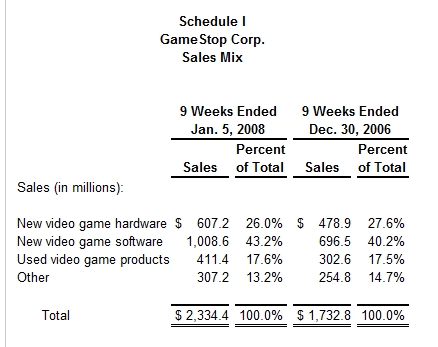
Looking at the financial information for the past two holiday seasons we see something interesting, or not.
As a percentage of sales GameStop's used video game business (all products) has held fairly constant and only gained a tenth of a percentage point. The biggest gainer has been their new video game sales which increased by 3% since last year.
Another thing to remember is that GameStop buys all used video games and consoles you bring in, they turn nothing away. They may only offer you $1 for that copy of Metroid Prime for the Game Cube but that is because they already 50 more used copies in the back room!
Let's take a moment to throw some figures around. Let's say that GameStop pays $25 for a video game that they turn around and sell for $50. If you bring that game back right away (and it is hot) you may get $20 in store credit (less in cash) for that game. At this point in the transaction GameStop is actually losing money as the $25 in profit they received when they sold the game has now been used to buy the game back from you only leaving them with a net profit of $5 on the game. This used game now resells for $45 and from here on out it is all profit, but only if it sells again.
If the used copies never move than GameStop is losing money on each used copy bought back. Every time they flip a used game they do make a good $25 in profit but, how many times can they flip a used game? How many gamers look at the $5 price difference and just buy the new copy?
What about game developers? If your game ends up on the used rack within a few days of the game's release does that not say something about your game?
- There are two types of games in the video game industry:
- Renters - These are your typical play-once games. A lot of RPG games fall into this category as once you beat the game there is no more point in playing it.
- Keepers - These are your games that have a ton of replayability. Most platformers fall into this category as well as multi-player online games.
If game developers would create games with long play times and high replayability those games would not be turned back in only days after being purchased.
Think about this, when you go to look at used games are their certain games that you always find there? Do these games have something in common? Perhaps they all suck?
How often do you ever find a copy of Super Smash Bros. in the used rack? What about the Pokemon games for the DS and GBA? Games that have a high replayability factor almost never show up in the used bin.
If you think used video games is a problem for the industry I think you are looking at this the wrong way. The booming used video game market is not a parasite or a plague on the video game industry it is a symptom of a larger problem. If the industry produced better games no one would be looking to sell their old games.
It's not just used games at GameStop either, what about Gamefly? Their business model is based entirely on renting video games. How many lost sales are created by the simple existence of Gamefly?
Used video game sales are not the problem. They never have been. If developers would focus on creating games that people will not want to trade-in the used market would not be as big as it is.


The only real problem that I find with this article is that you’re attributing the sole reason that people trade games in to them being bored with the game. I find that that isn’t always the case. I have traded in games not only because they had low replayability but also because I didn’t have enough cash on me to buy a newer game that I really wanted. There has also been a case where I’ve traded in games simply because my xbox was stolen and rather than buy a new xbox, I traded in the games towards my purchase of a Wii.
Overall though, excellent article.
Overall I think that selling used games is well a “rip-of” to the seller. About a week after Guitar Hero II came out my controller broke. My dad went to best buy and they gave us a new controller and game. So by then I had two GHII games. I went to my local mall where there is a EB games and a Gamestop (and I’m sure you know these two stores are affiliated). The game was un-wrapped in the plastic, and when I brought it to gamestop they said they couldn’t take it wrapped. “Go and take it down to EB, and un-wrap it.” I was a little iffy since it would lose its resale value, but I did it. I got $2.30. I was extremely upset. I could’ve traded it online for another game or two. Then when I went into the store a couple weeks later GHII used was selling for $10+. I just don’t understand how they make so much money off of used games. Aren’t people tired of this?
Many of the people selling it to GameStop are not worried about the profit they are making. It is usually the real feeling of needing the money.
I don’t necessarily agree with your difference in renter vs. keeper. For me and many others, a renter is a game you are probably on the fringe with. I wouldn’t buy it, but since I can rent it, I’d give it a shot and if I didn’t like it, back it goes.
Also, with an RPG they usually take a very long time so having it rented out can sometimes add up to more than the cost of the game if you spend many weeks/months with it. Plus rented games don’t usually have a manual, so complex games like an RPG are more difficult to get into without reading up on it.
It would be interesting to see Gamefly statistics and what genre of games are rented out most.
There are some benefits to used games to the industry:
1) Someone with say $30.00 might not want to spend $60.00 on a new game, but if they can grab 2 old titles off the shelf collecting dust, they might trade it in and get the new game. There’s a sale that wouldn’t have happened. I would bet a large percentage of tradeins are done so with the intent to buy something else and based on your chart, new sales eclipse used almost 3:1 (not factoring in the price difference mind you)
2) Used games give you a chance to try a new franchise or developer. I’m currently looking at Final Fantasy titles from the used shelf and if I enjoy them that will motivate me to buy some of the new titles (this same argument can be used for rentals too).
Many other goods also face the rental/used/new issue. Books have nearly no reuse value and can be checked out for free from the library, but they seem to be doing well. Movies are big time rentals, but the production companies do just fine selling them. Nearly every car finds its way to a trade in if they don’t go the trash heap first, so you have almost a 1:1 used, new car ratio out there.
I think the whole used/new is much ado about nothing. Developers and publishers should attempt to draw in the biggest crowd based on the development cost and create the best game they can if they want to maximize profits, not worry so much about selling new or used.
Replayability is nice and I agree that keeps games from hitting the used shelf, but alot of games aren’t built for replayability. You enjoyed the game now you move on. Just like a book, you read it it’s done now you move on.
I’ve worked for Gamestop in Poughkeepsie until about four months ago – I quit the job because of all the corporate bullshit. Believe me you give them far too much credit. It is only a very rare occasion that they give out over $18 for game thats been traded in. Usually it’s around $8-$11 (and giving only ten cents for a game and selling it for $7 is not unheard of either). All they speak of is the massive amount of money that they come into because of used sales and trade-ins. That’s why they force employees and managers to whore out their used selection and monitor their selling with secret shoppers – if you don’t offer used instead of new you are punished – sometimes at the cost of your job. That’s why they do it – because used sales and trade-ins generate so much revenue. That’s how they could buy-out all their competition – they bragged about it then and I’m sure they do to this day. So don’t feed me this crap about them not making much money on used sales and trades. Because it’s simply not true.
It is partially because of the developers? Absolutely. Is it partially because of consumers caving in on getting ripped off by large corporations? Absolutely. But saying that putting a large portion of blame upon Gamestop is going in the wrong direction make me wonder. Are you serious? Really?!
i truly believe that businesses like gamefly are the real cause in diminished game sales,i have countless friends who have only bought one or 2 xbox 360 games because they just rent a game till they beat it send it back in and get a new one, my one friend gets 2 games at a time and sends them back within 48 hours and plays between 8 -12 games a month and if he wants to play call of duty 4 online again he re rents it for a few days, people who do that are the ones hurting the industry, im actually surprised the gaming industry hasnt attacked gamefly yet!,esp since most consoles depend on game sales to balance out the amount of money lost per console sale